
Variable 1: U.N. Security Council Reform
Based on current trends, relations among the P5 risk moving from dysfunction to total paralysis over the coming years. Besides their opposing interests in the realm of high-level geopolitics, the United Nations Security Council (UNSC) may prove consistently unable to adopt resolutions on issues such as peacekeeping, sanctions, and punishment for war crimes. Cardinal norms of international peace and security (e.g., sovereignty, territorial integrity, and respect for international law) appear likely to remain subject to contested interpretations, even if they continue to enjoy nominal support.
The world is currently witnessing the proliferation of armed conflicts, a descent into great power competition, and mounting violations of international norms. Under these conditions, prospects for a universal order based on shared principles of global governance will become increasingly remote. And as mutual recriminations mount, there is a growing sense that the international order is reaching a tipping point.
Established powers have an interest in preserving the Security Council, given the avenues of influence it provides them.
Yet despite the sharp — and seemingly sharpening — differences exhibited in today’s international community, we must not forget the extent to which states still hold shared interests when it comes to preserving multilateralism and the role of the U.N. Security Council. Established powers have an interest in preserving the Security Council, given the avenues of influence it provides them. For their part, rising powers adamantly demand Security Council reform but still prefer it to be preserved as a forum for advancing their interests and mitigating conflict rather than have it drift into irrelevance. But structural and working methods reforms are urgently needed if the United Nations is to preserve its status as the premier forum for upholding international peace and security.
To that end, at the opening of the 82nd session of the U.N. General Assembly in 2027, after a consolidated model for reform has been presented in the Intergovernmental Negotiations (IGN) framework and text-based negotiations have begun, U.N. member states should vote to initiate a review of the U.N. Charter. According to Article 109 of the Charter, the decision to hold such a review can be taken with the support of two-thirds of General Assembly members and any nine Security Council members and is not subject to a veto.
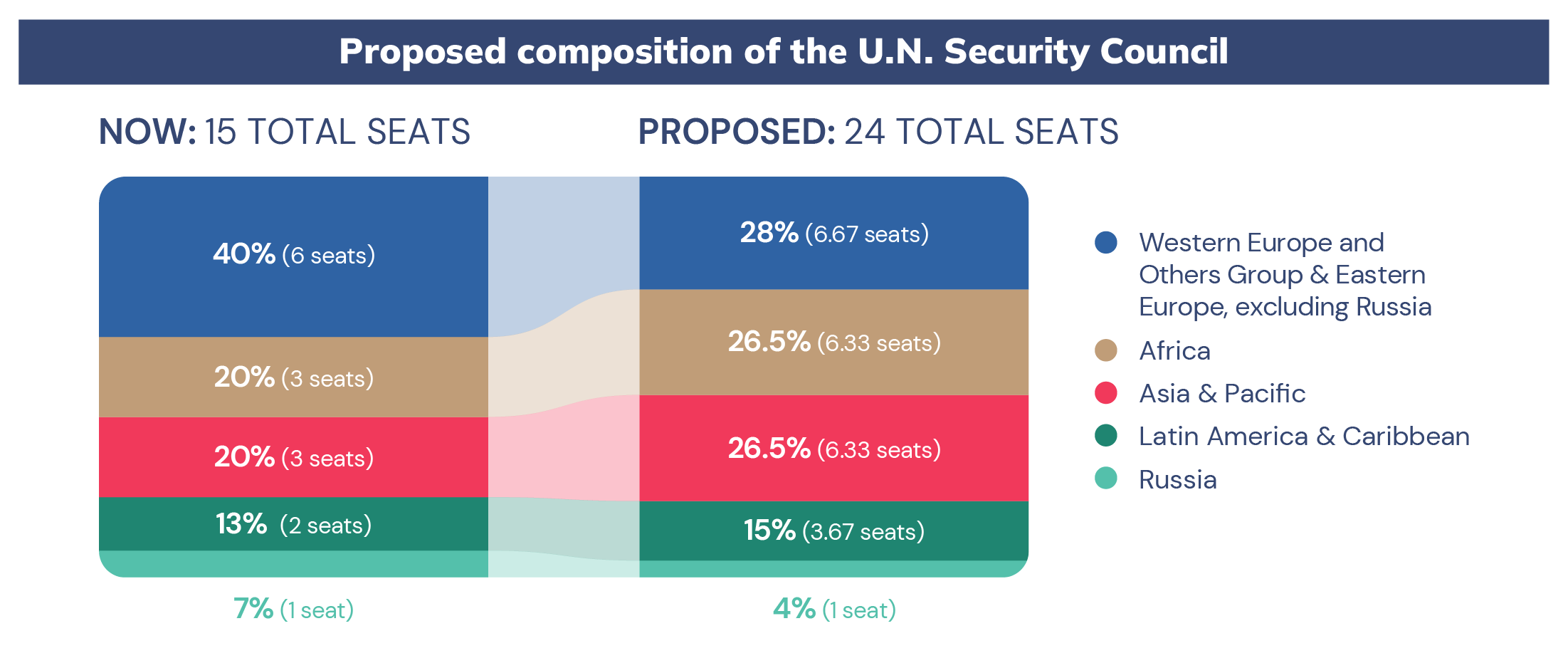
Both the drafting process and the adopted text of the Pact for the Future have made clear that reforming the Security Council remains a priority for member states. The proposals outlined below carry forward several priorities identified during negotiations over the draft, including improving the representation of Asia and the Pacific, Latin America and the Caribbean, and especially Africa; enlarging the Council in a fashion that improves the representation of small- and medium-sized states; finding an agreement on the question of the categories of membership; balancing representativeness and effectiveness; limiting the scope and use of the veto; and including a review clause to ensure that the Security Council remains fit for purpose over time.
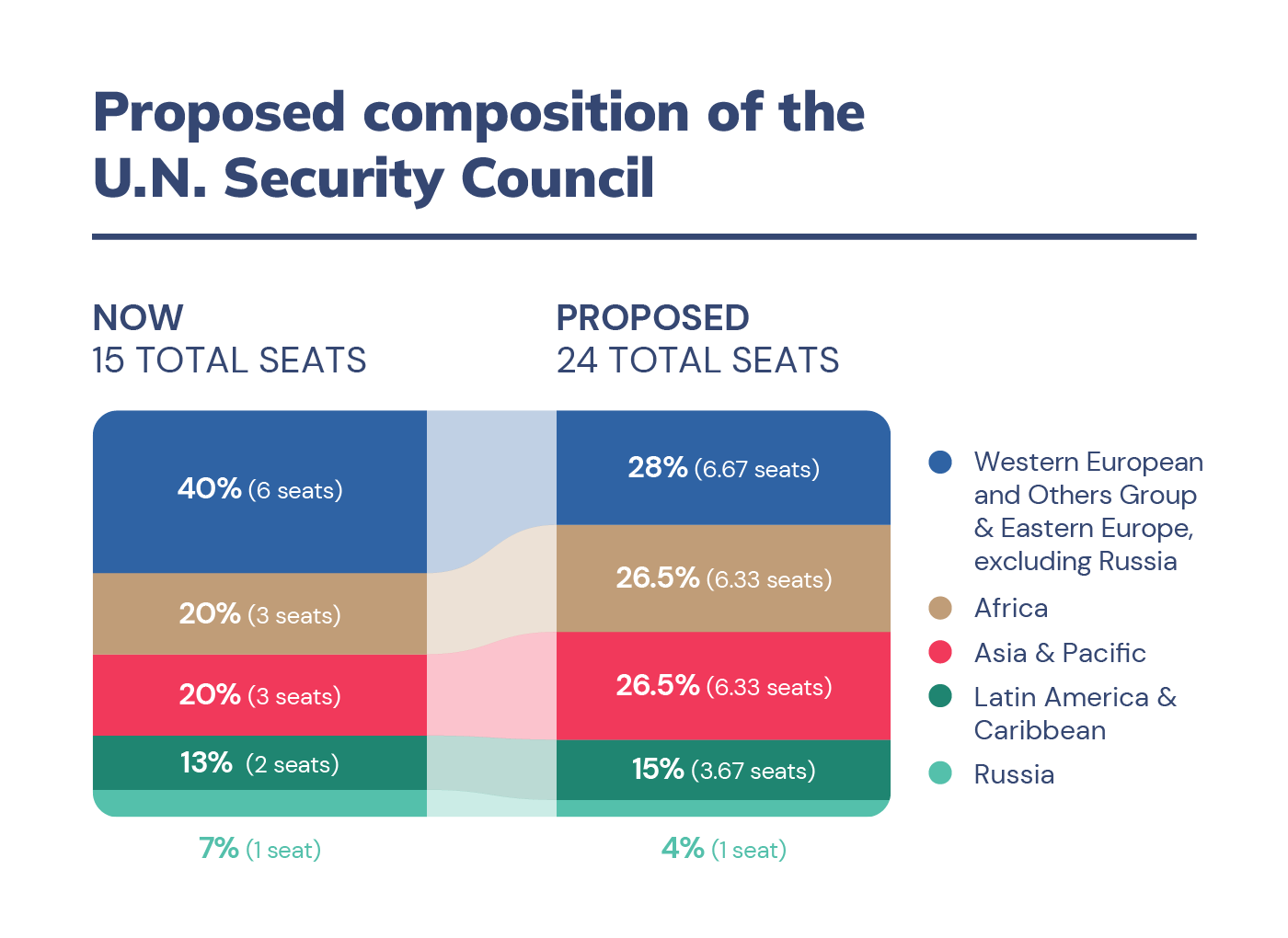
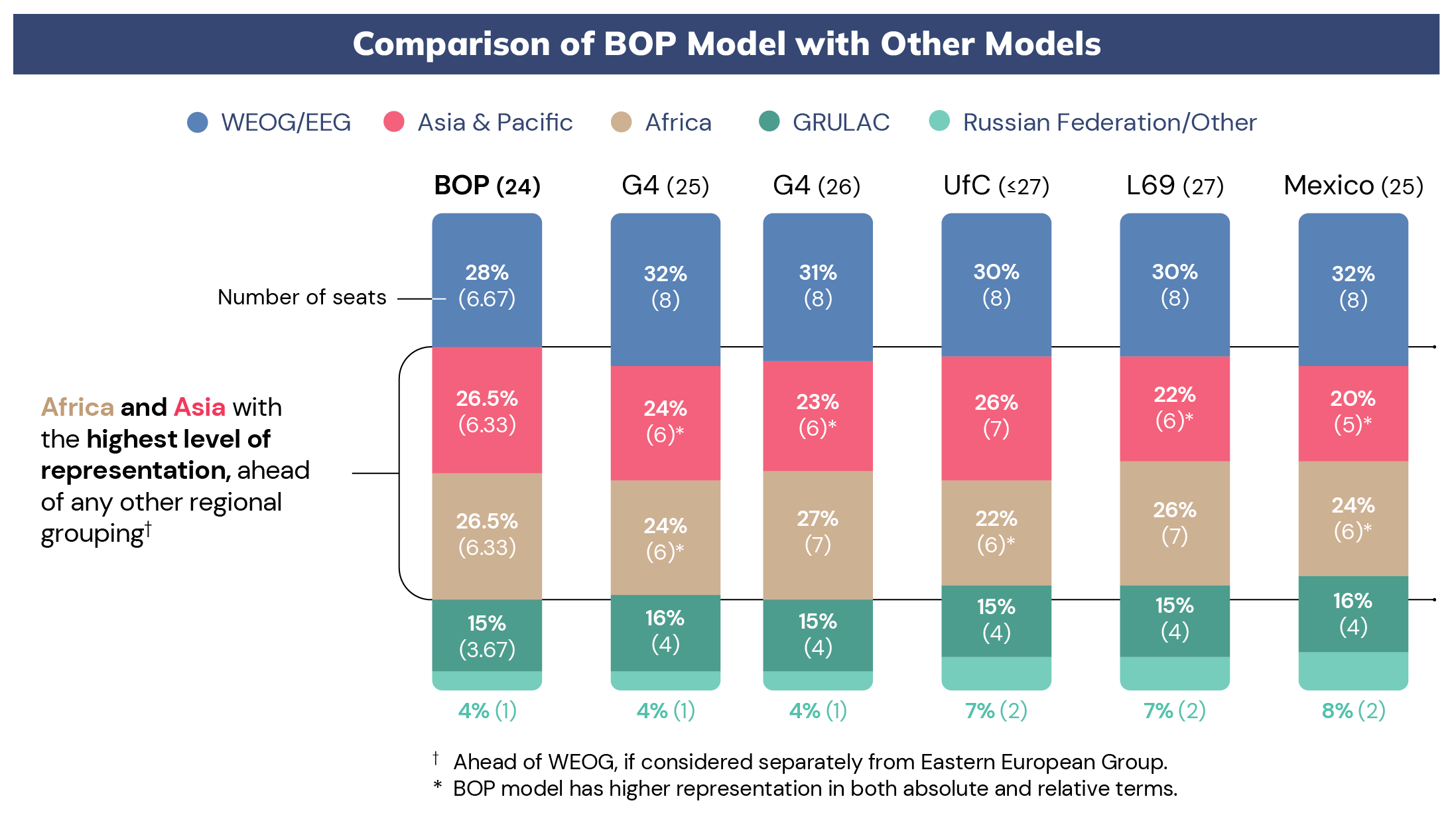
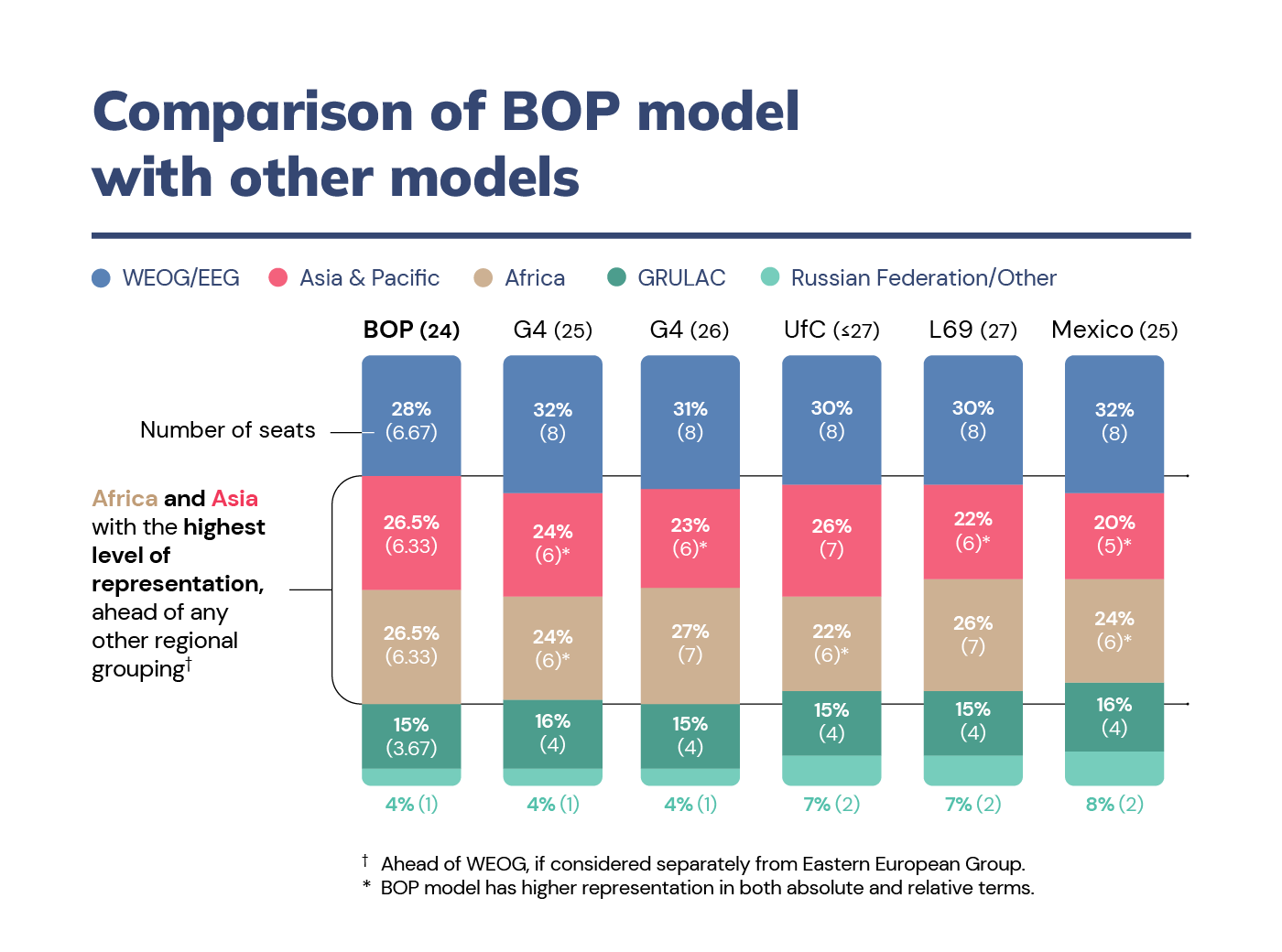
The formula we have developed in Proposal 1 would render Africa and Asia the two most represented regional groupings on the Council, ahead of the Western European and Others Group (WEOG).1 Our model gives Africa and Asia each more than 26 percent of the seats on the Security Council. No other existing model offers both Africa and Asia that high a level of representation at the same time. Moreover, unlike other models, the distribution envisaged by the Better Order Project offers Africa and Asia equal representation.
In addition to the proposals outlined below, amendments to the U.N. Charter should explicitly account for the importance of issues of planetary concern, making clear that the remit of the international community’s most inclusive body is no longer limited to issues of international or even global scope.
Proposal 1: Reforming the composition of the U.N. Security Council
Two specific reforms to the composition of the UNSC should be envisaged. First, given the growth in the number of countries of global influence since 1945, the number of permanent members should be increased. Second, a new semi-permanent category of members should be created to reflect the proliferation of countries of regional (and transregional) influence. The existing category of 10 elected members would remain untouched.
…the purpose of this reform is to create a ‘win-win-win’ formula through which countries of global influence, countries of regional influence, and smaller countries can all improve their positions….
The creation of three categories of states on the Security Council does not signal that multipolarity should be equated with hierarchy. Rather, the purpose of this reform is to create a “win-win-win” formula through which countries of global influence, countries of regional influence, and smaller countries can all improve their positions in the institutional architecture of the international order.
The proposed reforms would result in a total of just 24 seats on the Council — nine permanent, five semi-permanent, and 10 elected members — a manageable number not considerably higher than the current 15 and therefore more likely to win political approval. Of these 24 members, 15 affirmative votes should be required for the adoption of a UNSC resolution — a roughly equivalent share to the current nine out of 15.
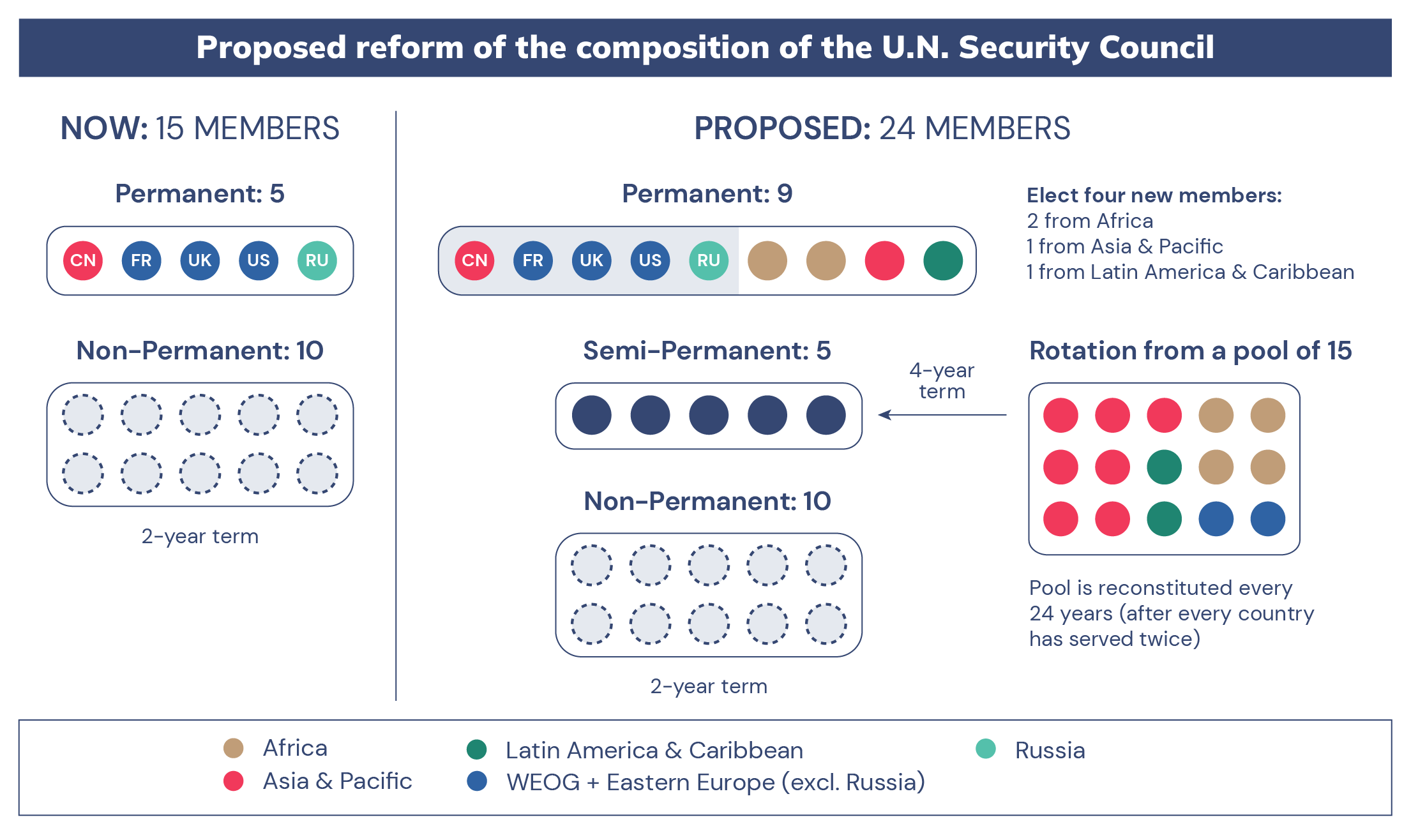
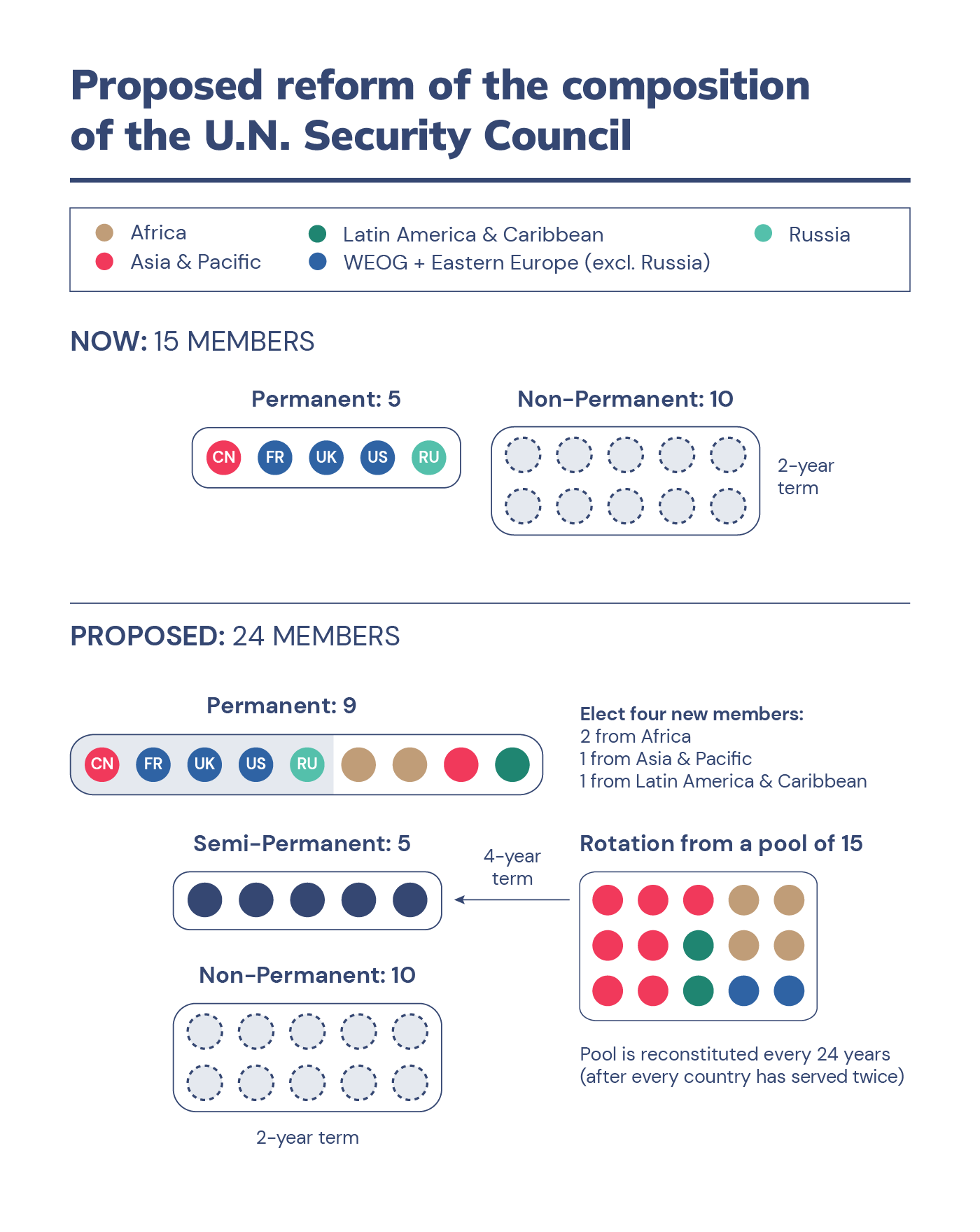
- First, four new permanent members should be added to the Security Council: two from Africa, one from Asia and the Pacific, and one from Latin America and the Caribbean. This formula is in line with the Pact for the Future’s recommendation under Action 39(a) to “[r]edress the historical injustice against Africa as a priority and, while treating Africa as a special case, improve the representation of the underrepresented and unrepresented regions and groups”.2
- These new permanent members should be elected by the General Assembly in a vote held two years after this formula is agreed upon, before the completion of the ratification process. Allowing the General Assembly to elect new permanent members strengthens the likelihood that the latter will be chosen for their positive contributions to international peace and security.
- The question of whether new permanent members will be afforded veto powers is addressed in Proposal 2. However, it is worth noting that the process of electing new permanent members in the General Assembly will, on its own, likely reduce veto usage. A country that promises (including through legally binding mechanisms) never to cast a veto — or to resort to one only in exceptional circumstances — will increase its chances of being elected to the Security Council.
- The African Group would be able to decide whether it wanted the occupants of its permanent seats to serve on a rotating basis, based on a formula agreed upon among its members.
- The existing P5, in fact, have an interest in growing their own ranks. By agreeing to extend permanent membership on the Council to regions that are currently underrepresented (or not represented at all), the P5 would strengthen the legitimacy of a body in which they would continue to occupy a privileged position.
- An expanded Council may also be a more effective one, as a permanent member may be more reluctant to bear the political costs of casting a lone negative vote in the face of opposition from an even greater number of permanent and non-permanent members. This would further increase the likelihood that vetoes are cast solely on issues of international peace and security or where a permanent member’s core interests are concerned.
- To avoid setting a potentially destabilizing precedent in which a permanent member is stripped of its seat, the current P5 should retain their status as permanent members of the Security Council.
- Second, once the election of the four new permanent members has been completed, the General Assembly should elect a pool of 15 semi-permanent members, five of which would serve on the Security Council at any given time.3 U.N. members elected to this category are likely to be countries of regional or transregional influence with a demonstrated record of contributing positively to international peace and security. These 15 countries would rotate on and off the Council, automatically serving for four out of every 12 years.
- These 15 countries should be distributed across the U.N.’s regional groupings as follows: seven should be drawn from Asia and the Pacific, four from Africa, two from Latin America and the Caribbean, and two from Eastern Europe and the Western European and Others Group (WEOG) combined. This formula is based on an approximation of the population of these respective U.N. groupings and the number of countries of regional influence each possesses, weighed against the need to improve representation for underrepresented regional groupings. That said, altering it as circumstances demand would not require a Charter amendment.
- After two rotations of 12 years (i.e., 24 years), the pool of semi-permanent members would be subject to review by way of fresh elections in the General Assembly.
- Having an extended turn on the Council once every 12 years — serving a guaranteed eight years out of 24 — would represent a marked improvement for countries of regional influence in comparison with the status quo. It would also offer compensation for those that failed to be elected to a permanent seat. With advanced knowledge of when their tenure will take place, semi-permanent members would be well prepared to make the most of their time on the Council.
- By diversifying the Council’s composition, the creation of the semi-permanent category would offer the 10 elected members of the Council more space to pursue their own agendas. This would be further facilitated thanks to the lengthier, four-year terms that semi-permanent members would serve, which (alongside the election of new permanent members) would ensure that more members than just the P5 possess a high degree of institutional memory and fluency in Council business. Smaller countries would also benefit from no longer needing to compete against 15 influential semi-permanent members (along with the four new permanent members) for an elected seat on the Council.
- Building on the existing practice of ensuring Arab representation, at least one of the Asian and one of the African seats in the semi-permanent pool should be reserved for an Arab country. However, given the number of Arab states that hold significant regional or transregional influence, it is likely that more than two total Arab states will be elected to the semi-permanent pool. If three Arab states are elected to the pool, it would amount to a de facto permanent seat for at least the next quarter-century (albeit without veto privileges), with the possibility of reelection.
- Regional groupings should also consider whether to set aside one of their semi-permanent seats for a Small Island Developing State (SIDS). For example, the Latin American and Caribbean states could set aside one of their two semi-permanent seats for a SIDS country, given that 16 of the 33 member states in this grouping fall under this category. Asia and the Pacific could also set aside one of its semi-permanent seats for this purpose, which would be open to African SIDS as well. Having two SIDS countries as part of the semi-permanent pool would only guarantee SIDS representation on the Council for eight out of every 12 years; however, it would ensure that a small number of SIDS will develop the strong institutional memory necessary to advance the political agenda of all SIDS more effectively.
To empower the 10 elected members of the Council even further, UNSC members should consider rotating the chairmanship of its subsidiary bodies annually. Such a reform to working methods would not require a Charter amendment. But even without this change, the expansion of the UNSC’s membership would, on its own, offer more opportunities to increase the number of resolutions tabled by members with no veto, as well as to reduce the extent to which established powers wield control over chairmanships and penholderships.
Proposal 2: Limiting the veto
As relations between the great powers have deteriorated over recent years, the Security Council has become increasingly paralyzed. Although the veto’s purpose is to provide great powers with a stake in upholding the international order and to encourage them to remain invested in its institutions, it has also called into question the legitimacy and effectiveness of the primary body tasked with upholding international peace and security. Securing sufficient support from U.N. member states for reforming the Security Council will be very difficult without visibly addressing the question of the veto.
…we propose several limited yet ambitious ways in which veto use could be reduced or restricted.
Any changes to veto privileges should be careful not to encourage further dissociation from multilateralism. Such an outcome may present itself if certain great powers conclude that the United Nations can no longer be trusted as a vehicle for upholding their core interests. Moreover, the employment of a veto can sometimes have positive effects: for example, protecting the sovereignty of smaller states by refusing to authorize a military intervention.
Nonetheless, we propose several limited yet ambitious ways in which veto use could be reduced or restricted. These changes should aim to enhance the body’s efficiency and thus support the interests of the international community, including the interest that the permanent membership has in preserving a functional and legitimate Security Council.
The following recommendations are the product of a compromise between project participants who defended the veto as a necessary prerogative and those who demanded restrictions on its use:
- First, the following restriction on veto privileges should be codified in the U.N. Charter. The strength of the limitation should be dependent on whether new permanent members are given veto privileges:
- In the event that new permanent members agree to forgo their veto privileges voluntarily, this should be done in exchange for the implementation of a “one plus one” mechanism, namely: a P5 member of the Security Council casting a veto will need to secure at least one negative vote from any other member of the Council for the veto to be secure from potential override. If, by contrast, the permanent member is the lone country casting a negative vote, then a two-thirds majority of the General Assembly can overturn the veto through the adoption of a GA resolution. This mechanism will help to level the playing field between the P5 and new permanent members, while also ensuring that new permanent members do not obtain unqualified veto privileges at a later date.
- In the event that new permanent members do obtain veto privileges, then there is a risk of more veto use and more paralysis on the Council. In this scenario, there will be a need for a stronger veto restriction: one veto plus two other negative votes should be required to insulate the veto from being vulnerable to a review of the General Assembly. Should such a review occur, in this case it should take place by secret ballot. (If discussions in the IGN settle on other accountability mechanisms to constrain new veto-wielding seats, such as subjecting the holders of those seats to fixed terms with the possibility of re-election, then a “one plus one” formula may prove sufficient.)
- In the context of an expanded Security Council membership, a country of global influence should be encouraged — and should easily prove able — to secure the support of just one (or two) of the other 23 Council members for its position. The overturning of a veto would be an exceptional development — one that is likely to occur only when an isolated great power has manifestly failed in its commitment to uphold international peace and security.
- Second, a new prerogative should be extended to the permanent Security Council members, allowing them to vote “no” on a resolution without exercising a veto. This would offer them a new way to respond to domestic political pressures while, at the same time, acting constructively in the face of a pressing need from another U.N. member state to pass a Security Council resolution. It would also raise the political cost of casting a full-blown veto, thereby disincentivizing permanent members from blocking resolutions in instances where the primary considerations are political and do not directly relate to the task of upholding peace.
- Third, the Peacebuilding Commission, which currently focuses on post-conflict peacebuilding and recovery, should be elevated within the U.N. system and be assigned some of the current responsibilities of the Security Council. One way to achieve this might be for the Trusteeship Council to be de facto transformed into a Peacebuilding Council. This development would foster a more democratic and a more efficient international order, while also helping to limit use of the veto to genuine and unquestioned issues of peace and security.
- Cases that do not directly involve a threat to international peace and security should ideally be transferred to the Peacebuilding Commission, allowing the UNSC to tackle a more focused agenda. This should be accomplished by way of a joint decision of the General Assembly and Security Council case by case.
- The General Assembly and Security Council might also consider empowering the Commission to select the cases it chooses to take on independently, including cases taken on at the request of an affected U.N. member state. It should be stipulated that this would not alter the current prerogatives of the Security Council under the U.N. Charter, up to and including the responsibility for authorizing the use of force.
- Topics that an elevated Peacebuilding Commission should address include environmental issues, health issues, education, and infrastructure, all of which fall under a broad sustainable development for peacebuilding definition. Neither peace operations, arms embargoes, sanctions, nor military interventions are pertinent to these issues, making the Security Council a less suitable forum for addressing them. Moreover, the permanent members of the UNSC do not hold special veto privileges on the Commission, and the affected country can be present.
- Resource allocation within the U.N. system should reflect the Commission’s higher caseload, and countries should be reassured that their cases will remain just as “high-profile” on the Commission as they were on the Security Council, given the redistributed workload. One might also consider adopting changes to the Commission’s voting structure, which currently operates on consensus, as it acquires a more robust mandate. If a country that does not pose a manifest threat to international peace and security (as determined in consultation with its immediate neighbors) wishes to remain on the UNSC agenda, it should be required to provide compelling arguments for this choice.
- Fourth, going forward, the process for electing a Secretary-General should begin with the selection of a candidate by the General Assembly, followed by the UNSC’s assent. This could allow for a stronger and more representative Secretary-General to emerge.
- Finally, certain changes to working methods aimed at reducing veto use and strengthening accountability can also be envisaged.
- Building on Liechtenstein’s veto initiative, which allows the General Assembly to convene within 10 working days of a UNSC resolution being vetoed, the GA should proactively make recommendations to UNSC members on how to avoid the disputes and disagreements that led to the casting of a given veto. This would strengthen intra-body dialogue at the U.N. and help ensure that the casting (or threat) of a veto does not entirely shut down debate.
- Relying on legal advice and drafting assistance provided by the Secretariat, a special working group should be established to draft General Assembly resolutions in advance on issues that are frequently subject to UNSC vetoes. This would allow the GA to act swiftly when needed in the context of a veto initiative meeting. The working group should be established — and its members selected — by way of a two-thirds majority vote of the General Assembly.
Proposal 3: Automatic Charter reviews
An amendment to the U.N. Charter should stipulate that a Charter review will be automatically held every 24 years. This would coincide with the conclusion of two cycles of semi-permanent members rotating on and off the Security Council, an appropriate juncture at which the entire package of reforms proposed above can be revisited. Those recommendations listed above that fail to garner the requisite support could be revisited during the next Charter review, by which point the diffusion of power and influence in the international order would have become even more manifest.
Automatic Charter reviews would render the task of Charter reform less politically charged, thereby enhancing both democracy within the U.N. system and the resilience of the organization (and, by extension, the international order) as a whole. Individual member states would be given the right to table amendments for debate, subject to existing adoption and ratification procedures.
Models for U.N. Security Council Reform: An AI analysis
Background
The United Nations Security Council (UNSC) is in crisis. Its composition reflects the world of 1945 rather than the world of today. And repeated misuse of the veto amid worsening great power relations has led to considerable gridlock. It remains an open question whether this body, tasked with upholding international peace and security, will remain fit for purpose in an increasingly multipolar world.
A formal Intergovernmental Negotiations (IGN) process at the U.N. on reforming the Security Council have been pursued since 2008, with little progress to show owing to sharply divergent positions among the principal players. However, for the first time in two decades, there is notable movement. The IGN co-chairs (currently Kuwait and the Netherlands) have put forward a “bridging proposal” aimed at getting U.N. member states to reconsider their established positions. This holds the promise that text-based negotiations could finally begin in the not-too-distant future.
The question remains how to reform the UNSC to render it more efficient, effective, and legitimate, all at the same time. Several models for reform have already been proposed.
The G4 countries — Germany, Japan, India, and Brazil — argue that the Council should be expanded to include new permanent members, including themselves, while showing flexibility on the immediate extension of veto rights. African states, represented through the African Union’s Ezulwini Consensus and led by the C–10 countries, also assert that two permanent seats should be set aside for Africa, with the same rights and privileges as existing permanent members for as long as the veto exists. The L.69 Group, a coalition of developing countries, similarly supports expansion in both the permanent and non-permanent categories to strengthen the representation of the Global South.
By contrast, Uniting for Consensus (UfC) — a group of 12 countries led by Italy — opposes expansion of the permanent category, arguing that growing the elected membership would better enhance the Council’s representativeness and accountability. UfC countries have also demonstrated an openness to creating longer-term renewable seats as an alternative to expanding the permanent category — an idea that features in models put forward by Mexico and Liechtenstein.
Two proposals have tried to reconcile these diametrically opposing positions. First, as mentioned, the IGN co-chairs have advanced a bridging proposal that features “fixed regional seats.” Under this model, additional long-term seats carrying the privileges of permanent membership would be allocated to regional groups, with their occupants elected by the General Assembly for renewable terms. Unlike the UfC proposal, these seats would be endowed with veto privileges. This proposal seeks to reconcile competing reform models by offering greater continuity and influence to advocates of permanent expansion, while preserving an element of democratic accountability through periodic reelection.
Second, the Better Order Project (BOP) has developed a model that envisages a limited expansion of the permanent category (two seats for Africa, one for Asia, and one for Latin America), along with a veto restriction whose criteria become steeper depending on whether new permanent members obtain veto rights. It also proposes no expansion of the non-permanent category, but rather the establishment of a “semi-permanent” category in which the General Assembly elects a 15–member pool of rotating members that each serve two automatic four-year terms. By taking these countries out of the running, it makes it easier for smaller countries to earn a standard non-permanent seat.
An AI simulation
Which sets of reforms will meet the needs of the future? To strengthen international stability and reinforce the foundations of multilateralism, the UNSC must be:
- Efficient (i.e., capable of taking decisions without excessive gridlock or delay)
- Effective (i.e., able to convert international crises into actionable, high-impact mandates rather than passing hollow, watered-down resolutions)
- Legitimate (i.e., corrects the historical underrepresentation of various regions, strengthens the status equality of its members, boasts greater transparency in decision-making, and enhances the ability of smaller states to vote their conscience without fear of superpower retaliation)
To answer this question, the Quincy Institute ran an AI simulation based on a continuous spatial voting model over a 50–year horizon, cross-referenced with a discrete linear utility model to adjust the initial findings, where necessary. The AI itself chose the definitional metrics provided above. The 50–year horizon allows enough simulated time for institutional effects to emerge, while avoiding forecasts so far into the future that the assumptions become dominated by uncertainty, with the acknowledgment that some of the structural effects of reform would still be developing after 20 or so years. Fifty years provides long enough for repeated crises, membership turnover, and coalition evolution.
The following models were compared:
- Status quo
- Status quo + full implementation of French–Mexican initiative and Accountability, Coherence and Transparency group recommendations to reform the UNSC’s working methods and limit veto usage
- G4/L.69 hybrid
- Uniting for Consensus (UfC), including the establishment of longer-term renewable seats
- IGN bridging proposal
- BOP–1 (new permanent members forgo veto privileges; the UNSC’s current Permanent 5 (P5) countries must find one accompanying negative vote on the Council to insulate a veto on a given resolution, otherwise the General Assembly (GA) by two-thirds majority can hold a public roll-call vote to override the veto)
- BOP–2 (new permanent members obtain veto privileges; permanent members must find two accompanying negative votes on the Council to insulate a veto on a given resolution, otherwise the GA by two-thirds majority can vote to override the veto by secret ballot)
Bottom line
Overall Governance Index
(0–1)SQ
SQ+
G4/L.69
UfC
IGN BP
BOP–1
BOP–2
0.48
0.54
0.49
0.61
0.53
0.81
0.81
The AI synthesized various metrics that measure efficiency, effectiveness, and legitimacy into an “Overall Governance Index,” a weighted composite macro-score that “measures how effectively the institutional model manages both the U.N. system and the wider international order.” It sees the G4 model and the bridging proposal as offering little improvement to the status quo; UfC, along with the bridging proposal when paired with a veto-override mechanism, as somewhat ameliorating overall governance; and the BOP model as a dramatic improvement over the status quo.
- Of all comprehensive models put forward to date, BOP–1 and BOP–2 perform best in terms of efficiency, effectiveness, and representativeness. BOP’s models are the only ones to balance the addition of new permanent members with the creation of a binding yet limited veto-restriction mechanism.
- While performing better than a G4–modeled Council in terms of overall governance, UfC does not address the fundamental issue of adjusting the composition of the Security Council to reflect the emerging balance of power — a measure likely necessary to render the U.N. fit for purpose in a post-unipolar world. As such, when measuring the model’s “constitutional stability” (i.e., international buy-in and resistance to decay) over a 50–year horizon, the AI predicts that the “unaddressed structural exclusion” of failing to expand the permanent category will generate “ongoing revisionist tension.”
- According to the AI simulation, the G4/L.69 model’s proposal to add new veto players to the Council would lead to considerable paralysis. This holds true even when accounting for the G4 countries’ offer to suspend their veto privileges for the first 15 years after obtaining permanent membership. The Ensemble Institutional–Agent Model (EIAM) that the AI employed relies on the assumption of strategic rationality: A state’s behavior is dictated by its exogenous geopolitical preferences and the institutional tools available to it. Even when hypothesizing that 15 years of building cross-regional coalitions would create path-dependent diplomatic habits, the spike in paralysis would be delayed only by approximately four to six years in the simulation. Assuming that institutional culture ultimately cannot override vital national security interests, in a severe exogenous shock a veto wielder would likely break the collaborative culture and use its newly acquired veto, rapidly resetting the Council to a higher baseline of paralysis.
- The IGN co-chairs’ bridging proposal aims to circumvent this very issue by subjecting veto holders to periodic reelection. However, the AI predicted that, by granting veto power to states that must constantly campaign for reelection, the model would structurally transform the veto from an emergency security brake into a transactional electoral commodity. In the simulation, renewable-veto states frequently used veto threats to logroll, secure regional patronage, and buy votes for their next election cycle. As the veto was repeatedly used for political self-preservation rather than international peace and security, the Council’s authority to demand global compliance degraded severely in the simulation.
While looking 50 years into the future inevitably involves a significant degree of uncertainty, the figures that the AI generated — and, even more crucially, the arguments — provide ample material for consideration as U.N. member states evaluate which institutional features are most likely to render the Security Council more efficient, effective, and legitimate.
Detailed analysis
Efficiency:
The AI contends that BOP–1’s public GA override mechanism would change the terminal conditions of bargaining. If a P5 member is isolated and lacks a Council ally to insulate their veto, the impending threat of a public GA override would force them to concede or compromise much faster. Conversely, if a P5 member did have an ally, they would know their veto is secure and can cast it decisively without protracted delay. In both scenarios, the time to reach a terminal outcome — either adoption or definitive veto — would be compressed.
By contrast, the proliferation of veto wielders in both the G4 model and the bridging proposal would slow Council deliberations considerably in comparison with the status quo. While Uniting for Consensus does not have this flaw, BOP–1 is the only model that would substantially improve on the status quo, while BOP–2’s veto-override mechanism would ensure that providing status equality to new permanent members (and thereby enhancing the Council’s perceived legitimacy in some respects) would not come at the expense of efficiency.
| Decision speed (days to resolution) |
SQ | SQ+ | G4/L.69 | UfC | IGN BP | BOP–1 | BOP–2 |
| 28.5 | 26.5 | 42.1 | 27.8 | 38.9 | 21.0 | 27.5 |
In fact, the existence of BOP’s veto mechanism would not only dramatically reduce the number of effective vetoes (i.e., insulated from GA review or ultimately upheld), it also would reduce the number of vetoes cast in the first place, compared with the status quo. This holds true for both BOP–1 and BOP–2, even though the latter would increase the number of veto players. The veto-override mechanism would encourage great powers to cast an isolated veto only when they perceive the cost to their interests and reputation of not casting one to be greater than the cost of casting one. In other words, veto usage would be more restricted to national interests of considerable significance, as opposed to frivolous use to score rhetorical points and give rival powers a black eye.
| Effective vetoes per decade |
SQ | SQ+ | G4/L.69 | UfC | IGN BP | BOP–1 | BOP–2 |
| 18.4 | 14.2 | 29.7 | 17.5 | 24.3 | 8.2 (11.4 ex ante) | 9.8 (16.5 ex ante) |
Effectiveness:
In the status quo, accommodating a solitary P5 holdout often requires stripping a resolution of its enforcement mechanisms, resulting in a mandate that passes but achieves nothing operationally. In BOP’s model, a P5 member cannot hold a robust resolution hostage purely on their own. To block it, they must convince at least one other state to absorb the reputational cost of a negative vote. If they were unable to find an ally in the simulation, they were often forced to accept a mandate closer to the median preference of the Council. Passing a compromise but actionable resolution scores higher in the AI’s effectiveness index than passing a hollow resolution or deadlocking entirely.
| Operational effectiveness (Index 0–1) |
SQ | SQ+ | G4/L.69 | UfC | IGN BP | BOP–1 | BOP–2 |
| 0.52 | 0.59 | 0.38 | 0.55 | 0.44 | 0.74 | 0.70 |
One might assume that the existence of a veto mechanism could encourage permanent members to ignore the outcome of an override, thereby reducing the legitimacy and influence of the Council. This is true, but would be mitigated by several factors according to the simulation:
- By failing to expand the permanent category, the UfC model would encourage rising powers such as India to dissociate themselves more and more from U.N. decisions in any event.
- The G4 model, while reflecting the global balance of power, would lead to a proliferation of cross-vetoing that ultimately would encourage permanent members to work periodically outside the Council, whether unilaterally or minilaterally. More veto-wielding members means more geopolitical redlines on the Council, and therefore more gridlock. This is visible in the considerable decline in operational effectiveness and cartel-capture resistance (see below) that the G4 model holds in comparison to the status quo, even when taking into account the 15–year veto moratorium of new permanent members.
Legitimacy:
Per the simulation, the veto mechanism in BOP’s proposal would dramatically increase the compliance of GA members along with regional implementation of UNSC resolutions. This is not only because the override mechanism would give the GA a sense of ownership over certain Council resolutions, but also because of the math in the GA.
The GA override mechanism would ensure that regional voices have structural influence over the final mandate. To achieve a two-thirds majority override under the BOP mechanism, a coalition needs 129 votes. If the African Group (54 votes) voted cohesively as a bloc to reject the override, the maximum possible remaining votes in the GA would be 139.
Securing 129 out of 139 available votes requires near-unanimous consent from the entire rest of the world — crossing deeply entrenched geopolitical divides (e.g., the U.S., Russia, China, the E.U., and Latin America all agreeing). The simulation therefore reveals that highly cohesive regional blocs effectively wield a collective structural veto over the GA override mechanism. Great powers would be forced to consult and appease regional blocs either to secure an override or protect their veto from one. This strengthens interbody dialogue at the U.N. and also allows for a decentralizing pressure valve of sorts in an increasingly regionalized world.
| Aggregate compliance (Weighted composite) |
SQ | SQ+ | G4/L.69 | UfC | IGN BP | BOP–1 | BOP–2 |
| 68% | 72% | 65% | 74% | 67% | 86% | 83% |
Because the Global South holds four vetoes and the GA enjoys a secret override in BOP–2, the GA is predicted to feel immense ownership over U.N. mandates and therefore enforce them rigorously. However, the simulation also found that the P5 would resent the higher rate of secret GA overrides, leading to foot-dragging and resource withholding by great powers. It therefore concluded that while BOP–2 would perform better in the sub-metric of GA compliance, BOP–1 would do better in aggregate compliance (which combines GA compliance with that of the great powers, other Council members, and the target state, along with regional implementation of agreed measures, into a weighted composite score of material mandate enforcement).
Further findings
Comparing the veto mechanisms: “1+1” versus “1+2”
BOP’s models propose that the proliferation of veto players requires a commensurate strengthening of the veto mechanism. As such, if the number of veto wielders increases from five to nine, then two measures are proposed to mitigate the risk of gridlock. First, a country wishing to cast a veto must find two (instead of one) concurring “no” votes to insulate its veto from a General Assembly review. And second, that review, if it occurs, would take place by secret ballot. Here is how the AI model sees these dynamics playing out:
- With a “1+1” mechanism (BOP–1), the great power may be deterred by the reputational cost of a public roll call. They know that a public override vote would force 193 ambassadors to stand in front of cameras, deliver speeches denouncing the great power, and register their opposition on the public record. To avoid this televised diplomatic spectacle, the great power would self-censor and moderate its behavior, casting fewer lone vetoes.
- With a “1+2 mechanism” (BOP–2), the great power knows an override would be mathematically more likely to succeed because the GA is voting its conscience. However, because the vote would be secret, the great power would avoid the public humiliation of a roll-call debate. Without the threat of “naming and shaming,” the reputational cost of casting the veto would drop significantly. As such, while the secret ballot would empower the General Assembly to override vetoes successfully, it paradoxically would remove the public shaming mechanism that deters great powers from casting those vetoes in the first place.
- At the same time, losing a secret ballot vote would still carry a reputational cost. The aggregate tally of the vote would remain public knowledge. This result would visibly prove that the great power could not muster even a one-third blocking minority. It would expose that its diplomatic threats and aid linkages failed. For many great powers, a crushing numerical defeat in a secret ballot would be reputational poison — even more damaging than a predictable, polarized public roll call.
BOP–2 would see more ex ante vetoes cast due to the higher number of veto players, but the secret ballot would result in a higher GA override rate (21% vs. 14.2%), leading to an average of around two more unresolved vetoes per decade in the BOP–2 model compared with BOP–1. The proliferation of veto players in BOP–2 also would lead to a slightly slower decision process than BOP–1, although not nearly as lengthy as in the G4 model. (As mentioned above, the BOP–2 model performs better than BOP–1 in perceived legitimacy and GA compliance with Council decisions, given that four new Global South players would be given equal veto privileges to the P5 in BOP–2 but would be denied this benefit in BOP–1.)
BOP’s veto-override mechanism would dramatically improve the Council’s immunity to being held hostage by a single great power wielding a veto (single-power capture resistance), as this country must find at least one concurring negative vote to prevent a GA review. BOP–2 suffers somewhat on the metric of cartel (i.e., multipower) capture, but still performs better than the G4 model across a 50–year horizon. Crucially, it also significantly outperforms the co-chairs’ bridging proposal, as outlined below.
The value of BOP’s semi-permanent category:
BOP’s model is unique in that it would create a third category, not in the form of long-term renewable seats (as proposed by Uniting for Consensus), but rather a pool of 15 countries who would take turns serving multiple longer terms on the Council. Election to this pool would guarantee a country two automatic four-year terms on the Council over a span of 24 years before needing to face the GA electorate once again.
Across the BOP–1 and BOP–2 models, the AI sees the main benefits of the semi-permanent category as follows:
- Operational stability: Replacing rapid two-year turnover with automatic four-year terms would allow semi-permanent members to develop institutional fluency and act as expert mediators between P5 members.
- Cartel-capture resistance: Significantly outperforms the IGN bridging proposal (0.64 vs. 0.28). Because semi-permanent members lack a veto, they cannot participate in veto-protection logrolling cartels.
- Small-state electoral access: By placing 15 regional heavyweights into a dedicated pool, the remaining 10 non-permanent seats would be cleared of heavy competition, tripling the election frequency for smaller states (e.g., Least Developed Countries, Small Island Developing States, and members of the Forum of Small States).
Unlike the veto-restriction mechanism and the addition of four Global South countries to the Council’s permanent membership, the semi-permanent category would focus on procedural optimization rather than macro-constitutional legitimacy. As such, it contributes only 0.04 to 0.05 points to improving BOP’s Overall Governance score, in contrast with 0.11 to 0.13 for expansion in the permanent category and 0.16 to 0.18 for the veto override. Still, the question remains: Is it preferable to have a small number of longer-term seats whose occupants are eligible for immediate reelection, as Uniting for Consensus proposes, or to have a rotating pool that offers more countries the opportunity to serve longer terms yet defers their need to seek reelection?
The AI identified several positive elements in UfC’s proposal:
- Single-power capture resistance: Surges from 0.42 (status quo) to 0.62. Serving consecutive lengthy terms would allow elected members to master Security Council procedures, build cross-regional coalitions, and establish the diplomatic weight necessary to resist bullying or agenda-hijacking by a single P5 power.
- Decision speed & efficiency: Compresses negotiation time down to 27.8 days (marginally faster than the status quo’s 28.5 days and drastically superior to the G4’s 42.1 days or the bridging proposal’s 40.5 days). Experienced long-term members would act as skilled non-veto mediators who would draft compromise language before P5 red lines were triggered. Operational effectiveness also would rise somewhat, to 0.55, from 0.52, as long-term members help negotiate actionable Chapter VII compromises rather than allow resolutions to be stripped of enforcement teeth or abandoned to deadlocks.
- Council member compliance: Increases to 85 percent, from 82 percent (status quo). States serving long, continuous terms would develop deeper institutional investment in the mandates they help craft over multiple years.
At the same time, the simulation identified several weaknesses in UfC’s proposal. First, by creating only a small number of seats for middle powers, several middle powers would still be forced to compete for non-permanent seats. By contrast, BOP’s model would clear the field by inducting 15 countries into the semi-permanent pool, making it much easier for smaller countries to earn a non-permanent seat. This boosts GA compliance with UNSC resolutions under BOP–1 to 79 percent even when the model is stripped of its veto-override mechanism, in comparison with UfC’s 74 percent and the status quo’s 68 percent. With the override, BOP–1’s GA compliance figure would surge to 86 percent.
Second, in the simulation, wealthy regional heavyweights (e.g., Germany, Japan, Brazil) would use continuous campaign spending to monopolize UfC’s long-term seats indefinitely through vote-buying and foreign aid. Moreover, because these members are constantly campaigning for immediate reelection, the simulation predicts they will form logrolling cartels, trading votes to shield allies and secure campaign backing. In short, according to the AI, “immediately renewable seats actually encourage selfish behavior,” whereas deferring reelection further into the future through a rotating pool would increase the chances that longer-term members will act in the interest of their regions and the wider international community.
The shortcomings of the IGN co-chairs’ bridging proposal:
Despite its repeated abuse in recent years, the veto does serve a purpose in stabilizing the international order by nominally preventing the frivolous use of military force by another great power. However, the AI simulation reveals that adding more vetoes would be problematic — and that allowing veto privileges periodically to shift hands would be even more problematic. While failing to enlarge the permanent category of membership has its own legitimacy costs, extending the veto to more actors may not increase the international community’s buy-in either.
Specifically, the simulation found that the BOP–1 and BOP–2 models dramatically outperform the bridging proposal on key metrics even when a 1+1 or 1+2 veto-override mechanism is attached to the latter.
- BOP’s models achieve a veto-override rate ranging from roughly 14 to 21 percent. By contrast, the “bridging proposal + veto-override” models would overturn vetoes merely 5 to 12 percent of the time, depending on whether it embraces a 1+1 public override vote or a 1+2 secret ballot vote. Because veto wielders must face reelection under the bridging proposal, they are expected to use foreign aid and regional patronage aggressively to punish states that vote against them in the GA, thereby suppressing the GA’s willingness to execute overrides.
- Cartel capture occurs when veto players logroll (trade favors) to protect one another’s core interests. According to the AI, the bridging proposal would fail “catastrophically” here — considerably worse than in any other model — precisely because its veto players would constantly have to run for reelection. To secure electoral support, veto wielders in the co-chairs’ proposal would trade companion “no” votes with one another, forming dense protection cartels that would completely neutralize the GA override mechanism. Knowing that their reelections depend on avoiding a humiliating GA defeat, they are predicted to form alliances on the Council to guarantee that companion votes are always provided. The AI calculates that, even with a 1+2 veto mechanism attached, the bridging proposal (0.41) would still perform worse at avoiding cartel capture than the weakest-performing established model (the G4 at 0.47).
- Regarding compliance, the AI asserts that “Because the General Assembly realizes the 11 veto players [in the bridging proposal] have colluded to render the veto-override mechanism largely ineffective, the broader U.N. membership does not develop the sense of procedural ownership that drives global compliance in the BOP models.”
| Metric (Index 0–1) | SQ | SQ+ | G4/L.69 | UfC | IGN BP | BOP–1 | BOP–2 |
| Single-power capture resistance | 0.42 | 0.48 | 0.25 | 0.62 | 0.25 | 0.85 | 0.86 |
| Cartel-capture resistance | 0.64 | 0.64 | 0.47 | 0.62 | 0.28 | 0.64 | 0.56 |
U.N. elections are highly transactional. General Assembly elections for Security Council seats are rarely decided by objective assessments of a country’s moral track record in upholding international peace. They are heavily determined by vote-trading, regional bloc endorsements, and “clean slate” arrangements (where regions agree internally on a single candidate). A state with a renewable veto has immense leverage. It can offer to shield regional allies from U.N. sanctions or critical resolutions in exchange for their votes in the next election. Small states in the GA, which often rely on regional heavyweights for security or economic aid, are highly susceptible to this pressure.
Adding a veto-override mechanism to the IGN model would increase its Overall Governance Index to a range of 0.60 to 0.65, from 0.53. This is stronger than the G4 model and comparable to the UfC model with longer-term renewable seats, but is a far cry from BOP’s model. In other words, even with a 1+1 veto mechanism added on, the bridging proposal performs roughly as well overall as the UfC model, which does not have such a mechanism. The flaw is in the IGN’s model’s institutional design: subjecting veto-wielding seats to reelection. Indeed, the AI sees this key feature of the co-chairs’ proposal as essentially neutering the veto-override mechanism: Since cartelization guarantees the necessary companion “no” vote, a single power could still hold the Council hostage by calling in a traded favor.
The P5 countries (who hold a veto over any structural reforms) remain opposed to extending the veto to non-permanent members, as they wish to avoid having to campaign every few years to prevent the “wrong” country from obtaining veto privileges. But if the co-chairs’ proposal were implemented, the AI sees renewable-veto members as becoming highly vulnerable to patron-client exploitation. A P5 power could offer to finance or lobby for a renewable-veto player’s reelection campaign in exchange for using its veto to block resolutions targeting the P5 country’s allies, without having to bear the reputational cost of casting the veto itself.
| Metric | Status Quo | Status Quo+ | G4/ L69 | UfC | BOP–1 | BOP–2 | IGN BP | IGN + 1+1 | IGN + 1+2 |
| Veto holders | 5 | 5 | 11 | 5 | 5 | 9 | 11 | 11 | 11 |
| Vetoes cast (ex ante) | 18.4 | 14.2 | 29.7 | 17.5 | 11.4 | 16.5 | 29.7 | 31.2 | 35.1 |
| Effective vetoes per decade | 18.4 | 14.2 | 29.7 | 17.5 | 8.2 | 9.8 | 29.7 | 26.5 | 24.1 |
| GA override success rate (%) | N/A | N/A | N/A | N/A | 14.2 | 21.0 | N/A | 5.2 | 12.1 |
| Deadlock probability (%) | 45.2 | 40.8 | 62.4 | 42.1 | 28.1 | 32.1 | 56.5 | 49.8 | 45.4 |
| Decision speed (days) | 28.5 | 26.5 | 42.1 | 27.8 | 21.0 | 27.5 | 42.1 | 38.5 | 35.2 |
| Operational effectiveness | 0.52 | 0.59 | 0.38 | 0.55 | 0.74 | 0.70 | 0.44 | 0.51 | 0.56 |
| Institutional legitimacy | 0.41 | 0.50 | 0.61 | 0.63 | 0.82 | 0.86 | 0.65 | 0.71 | 0.74 |
| Aggregate compliance | 68% | 72% | 65% | 74% | 86% | 83% | 67% | 68% | 69% |
| Single-power capture resistance | 0.42 | 0.48 | 0.25 | 0.62 | 0.85 | 0.86 | 0.25 | 0.45 | 0.50 |
| Cartel-capture resistance | 0.64 | 0.64 | 0.47 | 0.62 | 0.64 | 0.56 | 0.28 | 0.35 | 0.41 |
| Systemic buy-in/ resistance to decay | 0.56 | 0.58 | 0.59 | 0.69 | 0.81 | 0.91 | 0.58 | 0.64 | 0.68 |
| Overall Governance Index | 0.48 | 0.54 | 0.49 | 0.61 | 0.81 | 0.81 | 0.53 | 0.60 | 0.65 |
Even when taking away the veto-override mechanism from BOP’s proposal and assuming that it will feature nine veto players rather than five, and adjusting the bridging proposal to feature only four renewable-veto players instead of six, in the latter model more crises result in gridlock (51.8% vs. 46.2%), more vetoes occur per decade (25.8 vs. 21.4), and it takes more days (40.5 vs. 37.8) to adopt a resolution. To signal strength to domestic audiences, curry favor with regional blocs, or demonstrate loyalty to major power patrons, renewable-veto members in the simulation use the threat of a veto performatively.
Because the four new Global South veto seats in BOP’s model are permanent, those states do not have to engage in the transactional vote-buying and cartel behavior required to survive the bridging proposal’s electoral cycle. As such, while BOP’s cartel-capture resistance drops to an indexed 0.42 without the veto mechanism, it remains higher than the adjusted IGN model’s 0.33 (or 0.28 with six renewable-veto players).
| Metric | BOP composition (9 Vetoes, No override) | Modified IGN BP (4 Renewable vetoes, No override) |
| Vetoes cast (Count / decade) | 21.4 | 25.8 |
| Deadlock probability (% of crises) | 46.2% | 51.8% |
| Decision speed (Days to resolution) | 37.8 | 40.5 |
| Operational effectiveness (Index 0–1) | 0.52 | 0.47 |
| Institutional legitimacy (Index 0–1) | 0.77 | 0.69 |
| Aggregate compliance rate | 71% | 68% |
| Single-power capture resistance (Index 0–1) | 0.30 | 0.28 |
| Cartel-capture resistance (Index 0–1) | 0.42 | 0.33 |
| Systemic buy-in/ resistance to decay (Index 0–1) | 0.75 | 0.63 |
| Overall Governance Index (Index 0–1) | 0.59 | 0.54 |
When adding a 1+1 or 1+2 veto mechanism to the modified co-chairs’ proposal with just four renewable-veto players, the model’s Overall Governance Index jumps to a range of 0.65 to 0.69, considerably lower than BOP’s score of 0.81.
Conclusion
The results of the simulation are clear, detailed, and logical, even if one can quibble with precise figures over a 50–year time horizon.
Improving the functioning of the UNSC through voluntary pledges and changes to working methods would come with benefits. The increased diplomatic and reputational costs of violating the French–Mexican initiative’s pledge to withhold veto use in cases of mass atrocities would deter unilateral obstruction, reducing the number of vetoes cast and thereby marginally improving decision speed and operational effectiveness. Transparency measures would strengthen GA compliance as the broader U.N. membership would feel slightly less alienated from the Council’s day-to-day operations. Single-power capture resistance also would improve slightly due to increased procedural scrutiny. However, the Overall Governance Index remains capped at 0.54 for the “Status Quo Plus” scenario, revealing that technical reforms are not a substitute for structural change that addresses longstanding inequalities.
The G4/L.69 model does not substantially improve the UNSC’s contribution to U.N. and global governance — and at 0.49, it performs worse than the successful implementation of new norms and working methods. While the model does see legitimacy gains by adjusting its composition to reflect the emerging balance of power, these would be canceled out by a dramatic increase in veto usage, increasing deadlock, and slowing down Council business. Compliance with UNSC resolutions would fall, and the constitutional stability of the new order would be virtually identical to that of a Council without compositional reform. In short, even with a 15–year pledge to forgo veto privileges, growing the group of veto wielders would not create a more durable settlement over a 50–year horizon.
Absent a veto-restriction mechanism, the co-chairs’ bridging proposal fares roughly as strongly as mere voluntary pledges and working methods reforms. Again, gains in perceived compositional legitimacy would be wiped out by a consequential rise in veto use and decline in operational effectiveness. Subjecting veto wielders to fixed-length renewable terms would ensure that the Council’s ability to resist cartels is fatally weakened, dramatically so even in comparison to the G4 model (0.28 vs. 0.47). As such, the new system’s resistance to decay over the next 50 years would be barely changed from the status quo. Remarkably, even with a 1+2 veto mechanism attached, the AI predicts that the bridging proposal would perform considerably worse than UfC in avoiding deadlock, lengthy decision-making, and vetoes — even when discounting those vetoes that would be overturned by the GA.
This does not hold true for BOP’s model. Even when adding four new veto players, the veto-override mechanism would ensure that fewer vetoes are cast than under the status quo, even before any are overturned. Along with UfC (marginally), it is one of only two models that feature structural reform and succeed in reducing veto usage. Driven by high scores in compliance, effectiveness and legitimacy (including status equality in the case of BOP–2), the BOP proposal’s resistance to decay is in a different stratosphere compared with any other model. In fact, it remains higher than any other model’s even when stripped of its veto mechanism and assuming the advent of four new veto players.
The veto mechanism is a major reason behind the BOP model’s strong performance, accounting for roughly half the gains in Overall Governance Index, with the semi-permanent category and expanding the permanent membership together accounting for the other half. But even if the P5 did not agree to a veto-restriction mechanism, BOP performs well in comparison with Uniting for Consensus.
| Metric | UfC | Modified BOP–1 (5 vetoes, no override) | Modified BOP–2 (9 vetoes, No override) | BOP Semi-Perm. Pool (No new perm. seats, no override) | Modified IGN BP (4 elected vetoes) with 1+1 override | Modified IGN BP (4 elected vetoes) with 1+2 override |
| Vetoes cast (Count / decade) | 17.5 | 18 | 21.4 | 18 | 22.8 (27.2 ex ante) | 20.2 (28.4 ex ante) |
| Deadlock probability (% of crises) | 42.1% | 43.1% | 46.2% | 43.5% | 43.4% | 39.8% |
| Decision speed (days to resolution) | 27.8 | 28.1 | 37.8 | 28.3 | 34.2 | 31.5 |
| Operational effectiveness (Index 0–1) | 0.55 | 0.57 | 0.52 | 0.58 | 0.55 | 0.61 |
| Institutional legitimacy (Index 0–1) | 0.63 | 0.72 | 0.77 | 0.66 | 0.73 | 0.76 |
| Aggregate compliance | 74% | 77% | 71% | 76% | 71% | 73% |
| Single-power capture resistance (Index 0–1) | 0.62 | 0.68 | 0.30 | 0.65 | 0.55 | 0.58 |
| Cartel-capture resistance (Index 0–1) | 0.62 | 0.69 | 0.42 | 0.72 | 0.42 | 0.48 |
| Systemic buy-in/ resistance to decay (Index 0–1) | 0.69 | 0.76 | 0.75 | 0.71 | 0.68 | 0.71 |
| Overall Governance Index (Index 0–1) | 0.61 | 0.65 | 0.59 | 0.63 | 0.65 | 0.69 |
By contrast, the table above illustrates how the IGN co-chairs’ proposal, even with just four renewable-veto players and a veto-override mechanism attached, would perform worse than either UfC or BOP’s model stripped of its veto mechanism on every single metric save for deadlock probability, operational effectiveness, and overall governance (and even on these, the results are relatively comparable). This is before considering that such a proposal would feature not one but two elements likely to run into political opposition from the P5: a veto-override mechanism and the pairing of veto privileges with non-permanent seats.
To review the text of the entire AI simulation, click here.
- The Better Order Project’s model offers additional benefits for Asia and Africa as well. For
example, with seven semi-permanent seats (two or three of which would serve on the Council at
any given time), our proposal provides Asia with a greater degree of representation as the up to
four additional non-permanent seats offered by the Uniting for Consensus model. As for Africa,
the G4 proposal is the only model that may marginally provide more representation for Africa than the Better Order Project’s proposal — and this only if Africa is offered two non-permanent seats instead of one. But when factoring in the four-year term length of semi-permanent seats in the Better Order Project’s model, it is more advantageous for Africa to obtain four semi-permanent seats (one or two of which would serve on the Council at any given time) than to obtain two non-permanent seats.The Better Order Project’s model offers additional benefits for Asia and Africa as well. For example, with 7 semi-permanent seats (2.33 of whom would serve on the Council at any given time), our proposal provides Asia with a greater level of total representation (in relative terms) as the up to four additional non-permanent seats proposed by Uniting for Consensus. As for Africa, the G4 is the only model that may (marginally) provide more representation for Africa than the Better Order Project’s proposal — and this only if Africa is offered two non-permanent seats. But when also factoring in the greater term length of semi-permanent seats, it is more advantageous for Africa to obtain 4 semi-permanent seats (1.33 of whom would serve on the Council at any given time) than to obtain two non-permanent seats. ↩︎ - That said, it is worth noting the ways in which the Better Order Project’s proposal also stands
to benefit the WEOG and Eastern Europe. For example, although the model presented by
Mexico at the IGN offers these two regional groupings more combined relative representation
than any other model, it only sets aside one long-term seat for the WEOG, whereas our model
sets aside two such seats (represented on the Council for eight out of every 12 years) and also
allows Eastern European countries to compete for these seats.hat said, it is worth noting the ways in which the Better Order Project’s proposal also stands to benefit WEOG and Eastern Europe. For example, although the Mexican model offers these two regional groupings more combined relative representation than any other model, it only sets aside one long-term seat for WEOG, whereas our model sets aside two such seats (represented on the Council for 8 out of every 12 years) and also allows Eastern European countries to compete for these seats. ↩︎ - A variation of this idea was first advanced by Better Order Project participant Kishore
Mahbubani. ↩︎